
Pin It to the Board: How Peer Mentorship Is Promoting Digital Surgical Education in Uganda
Digital platforms expand access to surgical training, but local barriers often stall adoption. In Uganda, a Gulu University team is bridging this gap. By pairing a notice board campaign with peer mentorship, they show how to turn registered users into engaged learners.

The Gulu University team holding SURGhub QR codes ahead of the notice board campaign — the starting point of a peer-led effort to turn platform access into active learning.
The landscape of global surgical education is rapidly evolving, driven by platforms designed to democratise knowledge. In Uganda, a grassroots collective of medical students and early-career clinicians turned to SURGhub to help address local training inequities.
“The provision of learning resources is only the beginning of the surgical education journey”
The platform offers access to surgical courses outside traditional classrooms. Yet, as this community and one of its leading mentors, Dr Eric Ssennuni, have found, introducing a digital tool into a new environment reveals a fundamental challenge: the provision of learning resources is only the beginning of the surgical education journey.
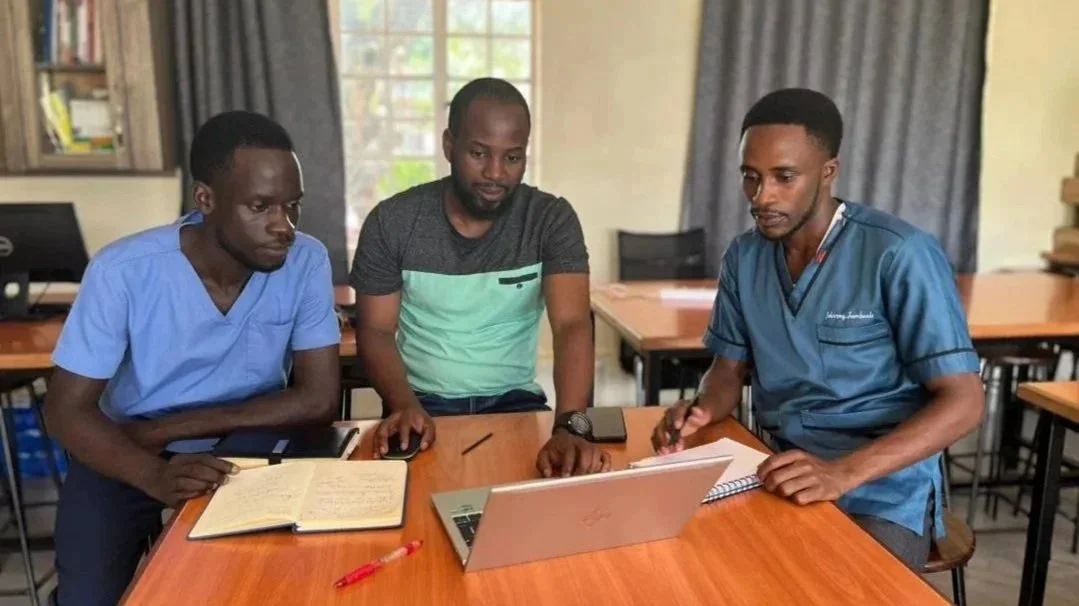
Dr Eric Ssennuni (central), with the two Gulu University student leaders — John (right) and Anthony (left), during the first project brainstorming meeting.
In Uganda, the local context presents complex, multifaceted challenges when it comes to access to surgical training. The grassroots team identified that access and adoption are not the same in resource-constrained settings, particularly when motivational and navigational barriers are left unaddressed.
Confronted with over 140 available courses, a student logging on for the first time can easily feel paralysed rather than empowered. As Eric notes, “In theory, anyone with a smartphone can access SURGhub, but in practice, access and adoption are two entirely different things.”
“Active peer mentorship bridges the gap between access and adoption”
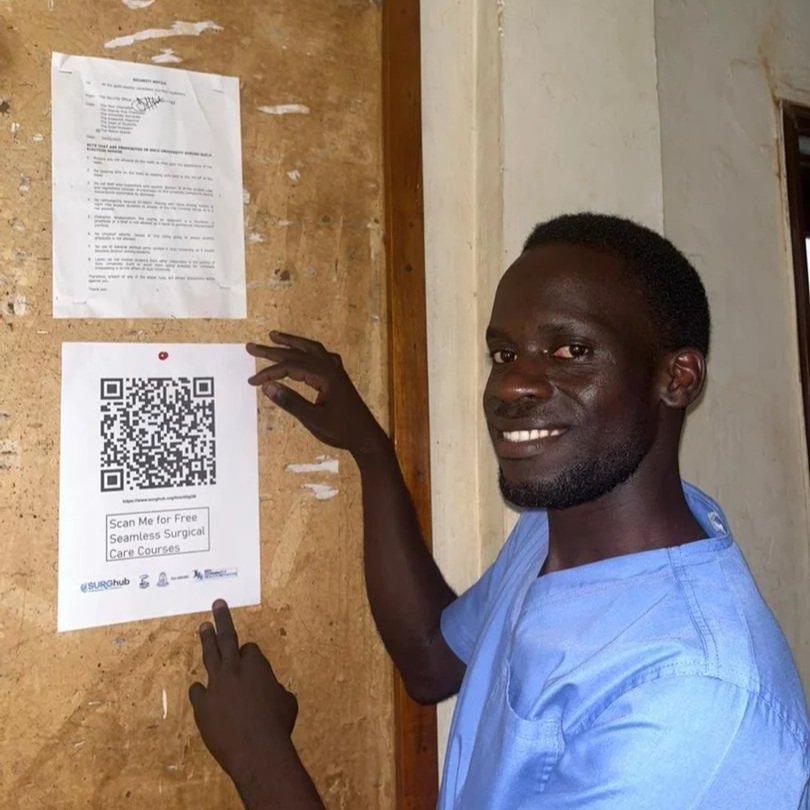
Anthony pinning a SURGhub QR code to a notice board at Gulu University Faculty of Medicine.
To overcome these local hurdles, the collective launched the “Pin It to the Notice Board” project, placing SURGhub QR codes across university and hospital notice boards to bring resources directly into the daily paths of students. Rather than relying solely on visibility, the team accompanied learners through the initial onboarding process.
They organised virtual and in-person sessions, providing guidance on platform navigation and offline app usage. Eric explains this approach: “It was at this point that we realised that access through the QR codes was just an invitation—navigational guidance and support were needed to turn this invitation into a learning commitment.” By establishing the Global Surgery Northern Start Mentorship Programme (GSNSMP), the team demonstrates how active peer mentorship bridges the gap between access and adoption.
“Success lies in cultivating engaged learners”
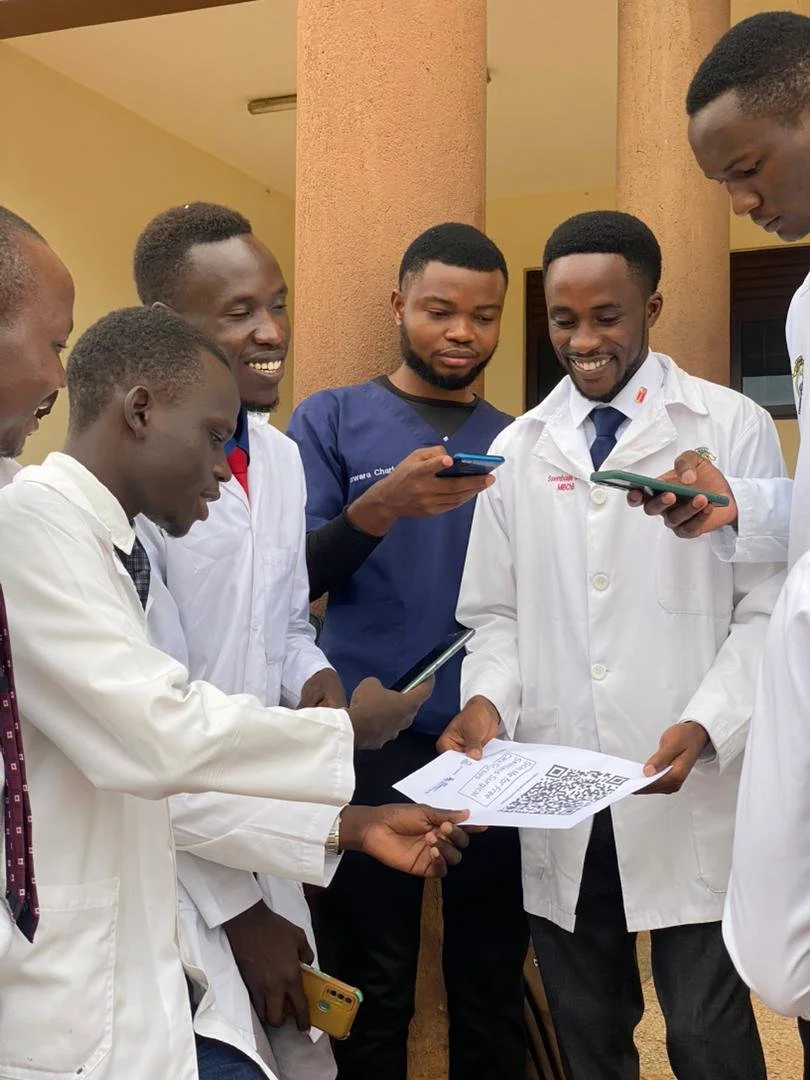
John walking students through the SURGhub QR code during an on-the-spot onboarding session
The key takeaway from this Ugandan initiative is that a global educational platform only reaches its potential through local adaptation. Establishing a digital repository is a necessary first step, but its value depends on communities being supported in navigating their specific barriers.
By pairing digital access with peer mentorship, the Gulu University collective showed that success means more than creating accounts. Colleagues who once hesitated are now engaging in clinical discussions with greater confidence. Groups that used the platform before hands-on sessions performed more cohesively during trauma resuscitation simulations. An initial registration, with the right support, can be the start of a long-term path for professional development.
What comes next
The second cohort of the Global Surgery Northern Start Mentorship Programme is currently running, with over 60 mentees from medical schools across Uganda and neighbouring countries. The team is also working to bring the notice board campaign to more medical schools and teaching hospitals across Uganda. As Eric puts it: "We envision a future where access to digital surgical education paired with human mentorship is not a novelty, but a standard fixture for every pre- and in-service healthcare professional in Uganda and beyond."
Eric’s recommended course
Navigating the Global Surgery Ecosystem
Topic: Global Surgery and how to navigate it.
Description: The course aims to empower frontline providers with knowledge and understanding of the global surgery landscape so they can effectively navigate and leverage it to meet local needs and ultimately inform and re-focus global surgery priorities.
"Access to digital surgical education paired with human mentorship should be a standard fixture — not a novelty."
- Dr Eric Ssennuni

About this Story
This article is part of our Spotlight series, exploring how communities around the world are putting SURGhub into practice. Each story looks at the people and initiatives working to make quality surgical education accessible where it is needed most.
The views and opinions expressed in this article are those of the individuals featured and do not necessarily reflect the official policy, position, or standpoint of SURGhub or its partner organisations.
About SURGhub
The United Nations Global Surgery Learning Hub (SURGhub) is the premier training platform in global surgical care. A joint initiative of the Global Surgery Foundation (GSF) and the United Nations Institute for Training and Research (UNITAR), supported by the Royal College of Surgeons in Ireland (RCSI) and implemented in association with the Johnson & Johnson Foundation, SURGhub provides seamless access to quality-assured online courses for frontline surgical care workers in resource-limited settings worldwide. With tens of thousands of learners across over 200 countries and territories, SURGhub is transforming access to lifesaving surgical education.
Your Next Article
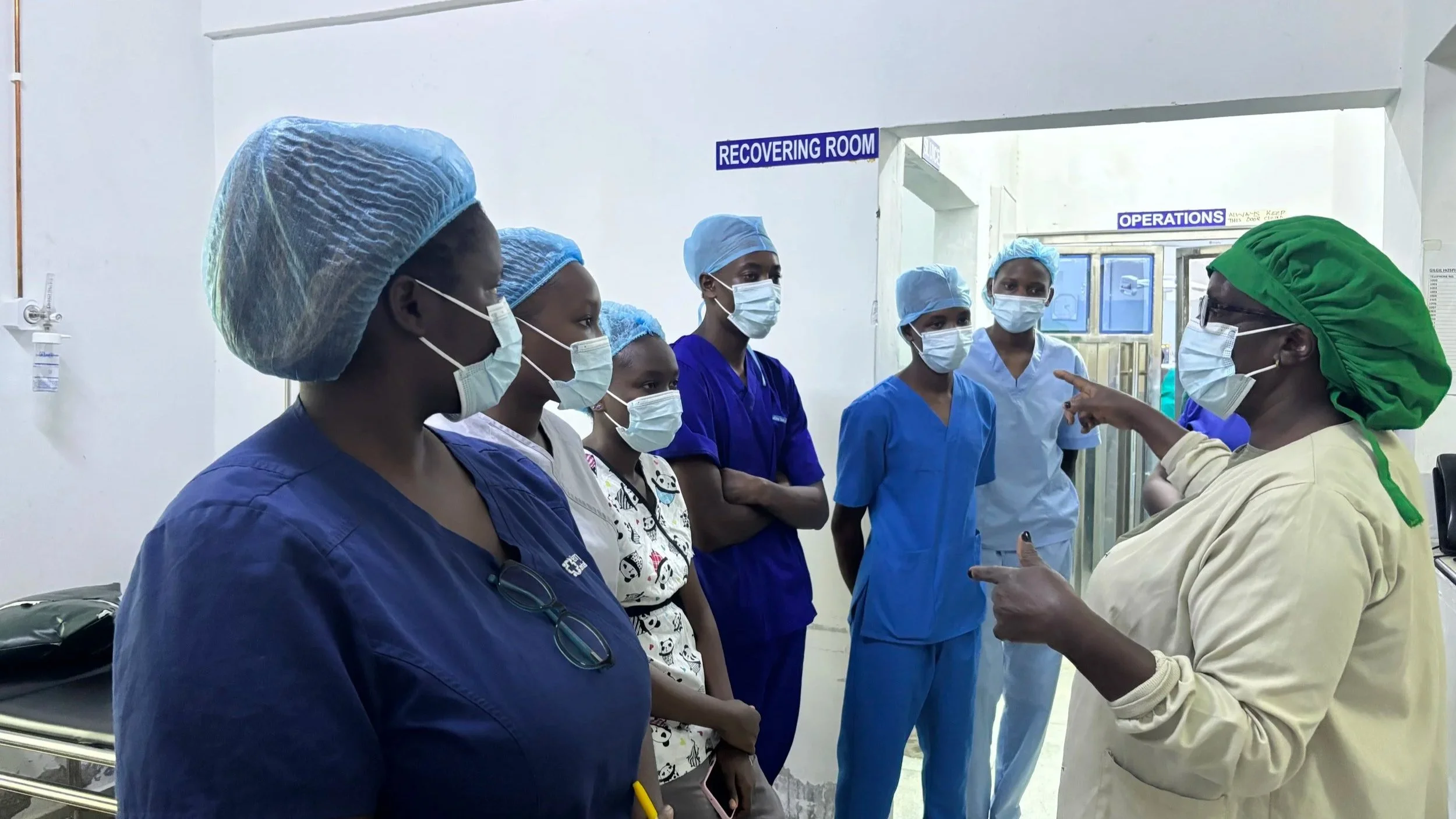
In Nakuru County, Kenya, a perioperative nurse and her surgical team are proving that when you invest in the people behind the operating table, the ripple effects reach far beyond theatre walls.