
On 17 November, the World Health Organization (WHO) and its partners mark World Cervical Cancer Elimination Day. Six years after 194 countries backed a plan to eliminate a cancer for the first time, reaching its 2030 targets depends on treatment, including surgical care, being within reach of every woman who needs it.

A 2024 study estimated that around 323,000 women diagnosed with cervical cancer each year need surgery at some point in their care. Photo: Geoff Ibbotson
A strategy to eliminate cervical cancer
On 17 November 2020, WHO launched the Global strategy to accelerate the elimination of cervical cancer as a public health problem, backed by 194 countries. WHO describes it as the first time the world committed to eliminating a cancer. WHO has marked the date with advocates every year since, and in May 2025 the World Health Assembly made it an official world health day through resolution WHA78.8. This year is the second time the day is observed with that status.
Cervical cancer is the fifth most commonly diagnosed cancer in women, with around 604,000 new cases and 280,000 deaths in 2024, according to WHO. The highest rates of new cases and deaths are in low- and middle-income countries, where access to HPV vaccination, screening, and treatment is uneven. Almost all cases are caused by a long-lasting infection with human papillomavirus (HPV), which is why the disease can largely be prevented, and cured when it is found early and treated promptly.
The 2026 theme
This year’s theme is “Together We Can Eliminate Cervical Cancer”, the slogan of a campaign that runs until 2030. Elimination means fewer than four new cases per 100,000 women each year. To get there, every country is asked to reach three targets by 2030, known as 90–70–90: 90% of girls fully vaccinated against HPV by the age of 15; 70% of women screened with a high-performance test by 35 and again by 45; and 90% of women found to have precancer or cancer receiving appropriate treatment.
WHO’s campaign messages ask countries to connect these steps, so that a woman who is screened can also be treated and followed up, and to build lasting systems with supported health workers, reliable supplies, and steady financing. Organisations can mark the day with their own activities and share them using #EndCervicalCancer.
Access to surgical care
Reaching the third target depends on the availability and accessibility of quality multimodal treatment, including surgical care, for women found to have precancerous lesions as well as invasive cancer. Early changes on the cervix can be removed or destroyed before they turn into cancer, through thermal ablation, which destroys the affected tissue with heat, or a loop excision procedure (LEEP), which removes it. When invasive cancer is found at an early stage, surgical care can also be critical to saving women’s lives (see Sally Agallo Kwenda’s story below). WHO counts surgery and radiotherapy, with or without chemotherapy, among the cost-effective treatments for early-stage disease. Where timely diagnosis and high-quality treatment are available, more than 80% of women with early-stage cervical cancer survive at least five years.
A 2024 study estimated that around 323,000 women diagnosed with cervical cancer each year need surgery at some point in their care, about half of them in low- and lower-middle-income countries. Yet WHO’s elimination strategy notes that in low-income countries, fewer than 5% of people with cancer have access to safe, effective, and timely cancer surgery. In many low- and middle-income countries, cancer operations are carried out by general surgeons, gynaecologists, and other doctors without specialist cancer training, and the strategy points to focused, skills-based training as a way to build that capacity. Vaccination and screening will reduce the number of women who need treatment over time. For the women already affected, the 90% treatment target means trained surgical teams and a strong surgical care system.
Survivor’s story
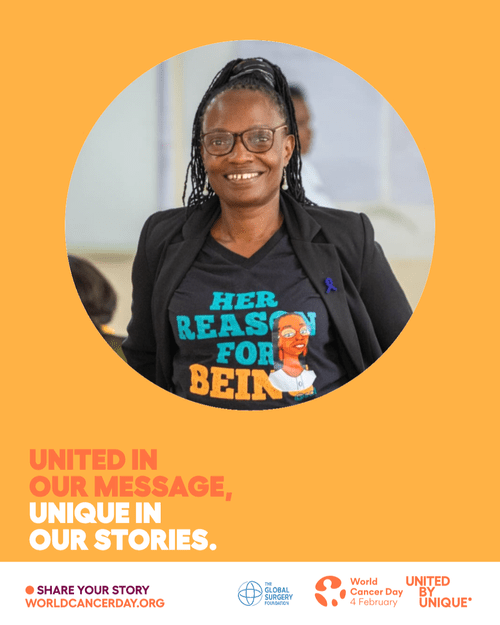
Sally Agallo Kwenda, Kenya
“I wouldn’t be alive without access to safe and timely surgery.”
Sally was diagnosed with stage II cervical cancer and needed surgery as soon as possible. Support from her employer and good insurance cover meant she could have several operations over a number of years. She has advocated for people living with cancer through her work with the NCD Alliance in Kenya.
Many women do not have that support. Sally told GSF that facilities with the right equipment and staff can be more than 600 kilometres away, in Nairobi or Eldoret, and that for women without insurance, “time spent fundraising can allow the cancer to spread.”
“Time is critical…once the cancer is advanced, then surgery is not an option.”
Read Sally’s full story in our Voices of Global Surgery series
How to take part
Share what your team or organisation is doing using #EndCervicalCancer, and add your experience to the WHO and Healthcare Information For All (HIFA) discussion on what helps women get screened and complete treatment. Join the campaign
About this Article
This article links to material published by third parties and summarises it as stated in the source. It is provided for information only, is not clinical guidance, and does not imply endorsement by the Global Surgery Foundation or its project partners. Readers should consult the primary source before acting on the material, which is not routinely updated.
About the Global Surgery Foundation
The Global Surgery Foundation (GSF) is the lead global platform for surgical care systems strengthening. Operating on a UN-incubated, neutral platform, GSF mobilises world-class clinical, policy, and funding expertise to support local leaders in building surgical systems that are efficient, resilient, and sustainable. Through SURGfund — the world's first and only pooled financing mechanism for surgical care — and SURGhub — the UN Global Surgery Learning Hub — GSF is translating catalytic investment into measurable, lifesaving impact across low- and middle-income countries.
Your Next Article
On 15 November, people around the world remembered those killed and injured on the roads, and the care that can decide what happens in the first minutes after a crash. Read article.