
Most Low-resource Surgical Simulation Uses Low-cost Tools
A new journal review of 50 years of change in surgical education finds that most simulation in low-resource settings uses low-cost, locally sourced task trainers.
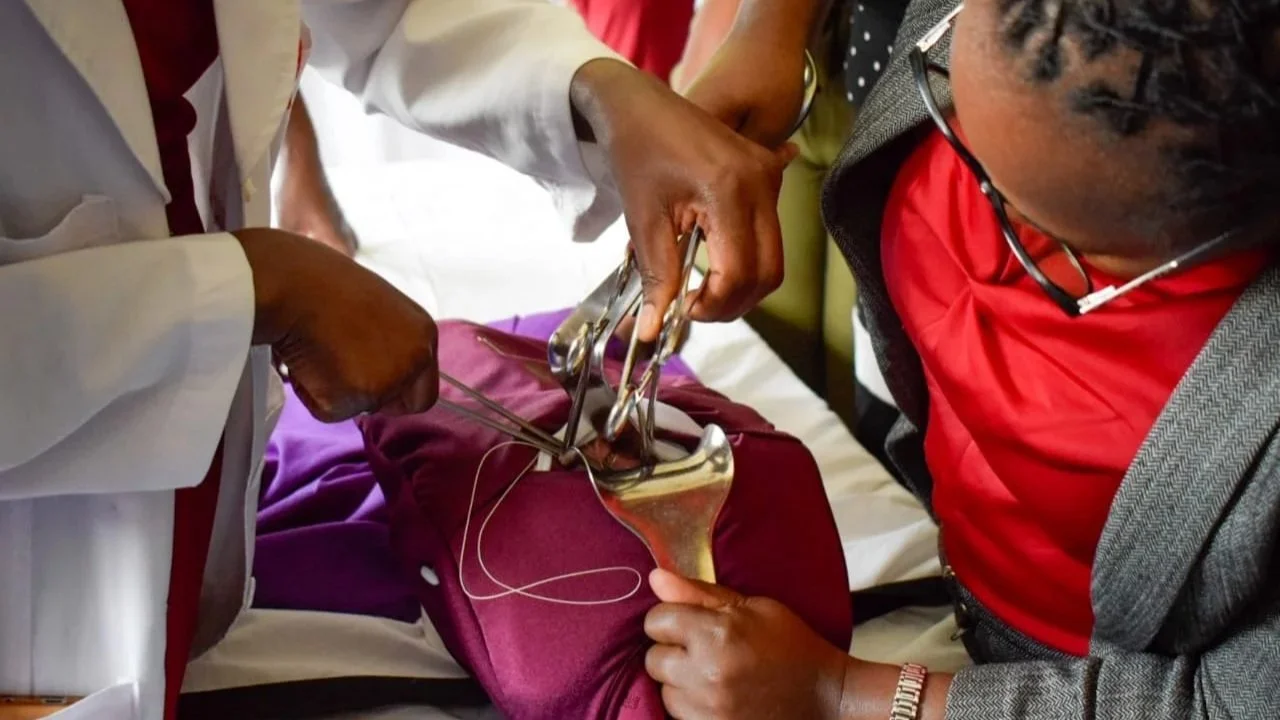
Surgical teams train on a caesarean section simulator during a SURGfund-supported training programme.
A review of five key advances in global surgical education over the past 50 years has been published in the World Journal of Surgery (WJS) by authors affiliated with the United Nations Global Surgery Learning Hub (SURGhub). It was accepted for publication on 23 March 2026.
Competency frameworks displaced apprenticeship training by the late 20th century
Early surgical education relied on apprenticeship, with trainees learning through observation and imitation. Reduced working hours, patient safety concerns and increasingly complex procedures made that model insufficient, prompting structured residency programmes with standardised curricula. Competency-based education required proficiency across technical skills, communication, decision-making and systems-based practice, replacing time-based progression with holistic evaluation. According to the authors, this transformation has largely been driven by high-income country (HIC) models that do not always align with the clinical realities of the Global South or rural communities.
Around 80% of simulation learning in low-resource settings uses low-cost materials
Simulation has expanded from early laparoscopic skills work into a field spanning virtual reality, box trainers, 3D printing and robotic simulators. It matches or surpasses traditional patient-based training when embedded in structured curricula and proficiency-based programmes. Implementation varies by setting: in resource-limited regions, approximately 80% of simulation-based learning is achieved through low-cost, locally sourced materials and task trainers. The WJS article notes underuse of simulators, high costs and limited uptake in low- and middle-income countries as persistent challenges.
Laparoscopy reshaped curricula worldwide; first acknowledged case performed in 1987
The first acknowledged laparoscopic cholecystectomy was performed in 1987 using four trocars, and almost every abdominal operation can now be completed laparoscopically. Robotic systems required simulation-based training, structured credentialing and supervised console time. The authors describe a resulting paradox: many residents trained in HICs finish their programmes with very little experience of open surgery, which remains lifesaving where technology is unavailable. Remote learning, recorded surgical videos, digital case libraries and tele-mentoring now define contemporary training, with milestones including the launch of SURGhub in 2023 and the emergence of artificial-intelligence-based educational tools after a public software release in 2022.
Surgical and trauma teams depend on training that keeps pace with changing techniques, and the models used shape what can be delivered locally.
Your Next Article
The Global Surgery Foundation’s 2025 Annual Report marks a decisive turning point for global health. Read more