
The New York Times has reported on a calibrated drape that helps midwives in Kano, Nigeria, spot heavy bleeding after birth early. Prof. Hadiza Galadanci, who oversaw the research in Nigeria, leads the Making Caesarean Section Safe in Kano project with her team at ACEPHAP.
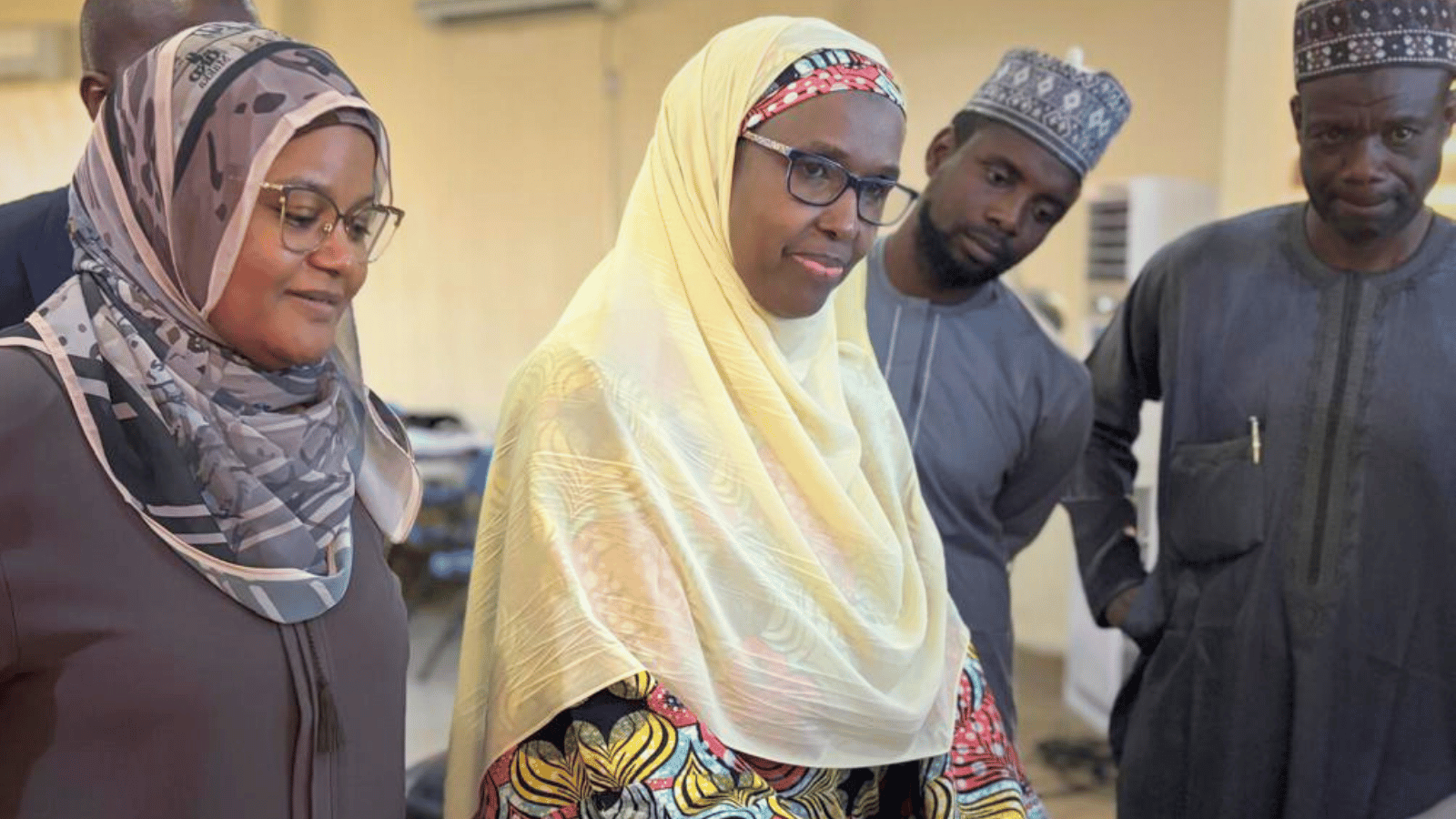
Prof. Hadiza Galadanci (centre) at the launch of the Making Caesarean Section Safe in Kano project.
The report
On 3 November 2026, The New York Times published a report by global health reporter Stephanie Nolen on the maternal drape, a calibrated plastic sheet with a pouch that measures blood loss after birth. The report follows its use in maternity wards in Kano, Nigeria, and the work of Prof. Hadiza Galadanci, professor of obstetrics and gynaecology at Bayero University Kano, who oversaw the Nigerian research.
How the drape works
Postpartum haemorrhage, heavy bleeding after birth, is the leading cause of maternal death worldwide. Blood loss is hard to judge by eye, and health workers often underestimate it. The drape lies under the woman during birth and collects blood in a pouch with graduated markings. When the blood passes the 300 millilitre mark, the team gives a bundle of treatments at the same time: uterine massage, oxytocin, tranexamic acid, and intravenous fluids.
“It’s like turning off a tap,” Prof. Galadanci told The New York Times.
According to the report, the drape and the treatment bundle are now being introduced across Nigeria, and the drapes are made in Kano by a local manufacturer for about 80 cents each.
When surgery is needed
If the bleeding does not stop, or if a woman needs a caesarean section, she needs an operating theatre, a trained surgical and anaesthesia team, and access to blood. The report describes one Kano maternity clinic where a single obstetrician had three urgent caesarean sections waiting.
Safer caesarean sections in Kano
Prof. Galadanci’s team at ACEPHAP, Bayero University Kano, also leads the Making Caesarean Section Safe in Kano project with the Kano State Ministry of Health, with funding and accompaniment from GSF. The project trains and supports surgical teams in ten hospitals in Kano State, and we are now supporting its expansion to five more facilities in neighbouring Jigawa State.
Read the article in The New York Times (free with a New York Times account).
Learn more on SURGhub
Our course Use of Heat-Stable Carbetocin for Prevention of Postpartum Haemorrhage (PPH) at Caesarean Section covers one of the medicines WHO recommends for preventing PPH. It takes less than an hour to complete and is designed for obstetric, anaesthesia, midwifery, and perioperative nursing teams.
About the project
The Making Caesarean Section Safe in Kano project works to improve maternal and perinatal outcomes through safe, timely, appropriate, and respectful caesarean section care for more than 27,000 women giving birth each year in Kano State, Nigeria. Using a hub-and-spoke mentorship model across ten facilities, it trains interdisciplinary surgical teams in the caesarean section-adapted Surgical Safety Checklist, evidence-based surgical techniques, teamwork and communication, and a culture of patient safety. It is led by ACEPHAP at Bayero University with the Kano State Ministry of Health, with funding through SURGfund and accompaniment from GSF.
globalsurgeryfoundation.org/safe-cs-kano
Your Next Article
Health workers around the world see where surgical care falls short. In Voices of Global Surgery we highlight their stories. Read Article.