GSF joins BCIU and BD for UNGA event on maternal safety during childbirth
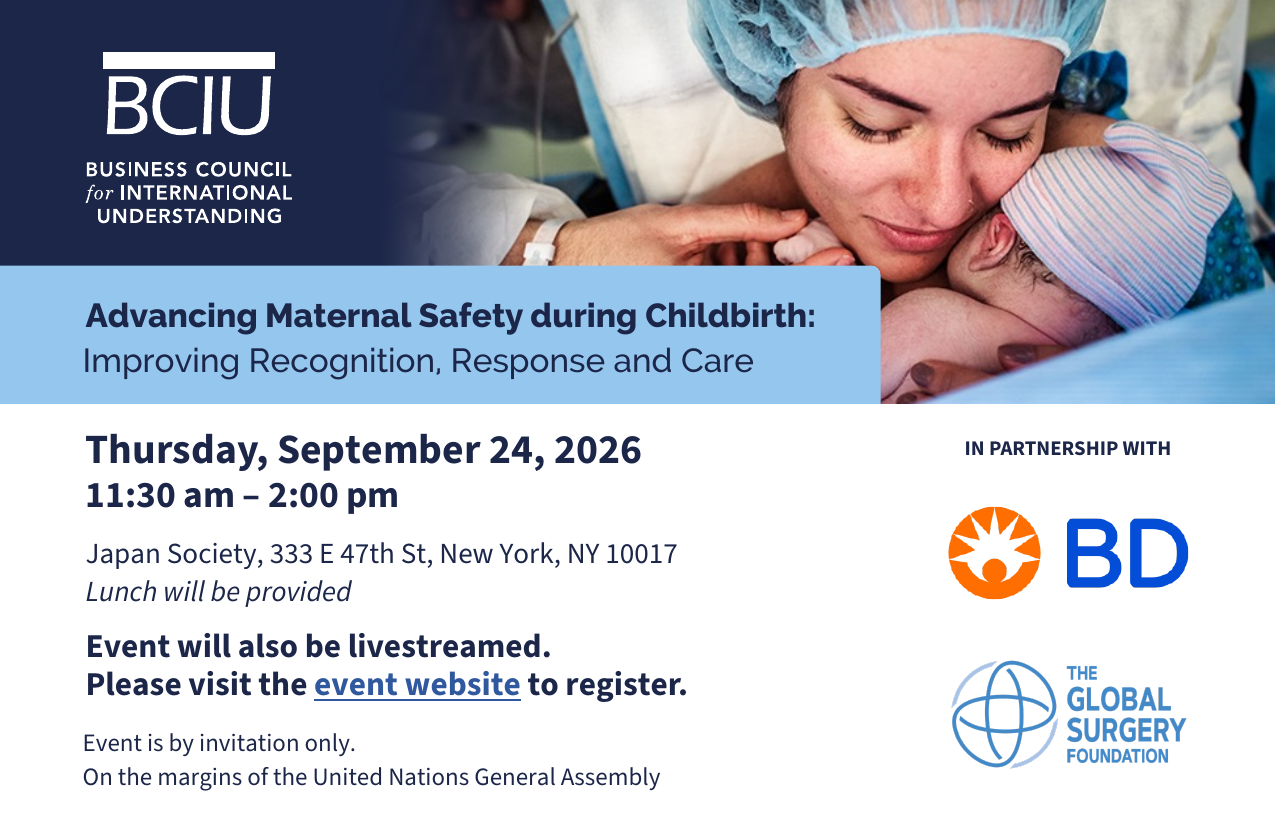
The Business Council for International Understanding will host Advancing Maternal Safety during Childbirth: Improving Recognition, Response and Care in New York on 24 September, in partnership with Becton Dickinson and Company and the Global Surgery Foundation.
New York, 24 September 2026. In-person attendance is by invitation only, with registration open for the livestream.
Background
Maternal mortality remains one of the clearest measures of whether a health system works. In 2023 an estimated 260,000 women died from causes related to pregnancy and childbirth, around 712 deaths each day, and the global maternal mortality ratio remained close to three times the level implied by Sustainable Development Goal target 3.1 for 2030. Postpartum haemorrhage is the leading cause of maternal death worldwide, and most of them are preventable with timely recognition and treatment.
The pattern behind those figures is consistent. Women face delays in reaching caesarean section when it is clinically indicated. Once they are in a facility, the standard of monitoring they receive is often decades out of date. And when a woman begins to deteriorate, whether during a caesarean delivery or in the hours immediately afterwards, that deterioration is frequently recognised too late. The window in which intervention makes the difference between a routine recovery and a death is short, and it closes quietly.
The event
On Thursday 24 September 2026, on the margins of the eighty-first session of the United Nations General Assembly, the Business Council for International Understanding (BCIU) will host an event on that gap in partnership with Becton Dickinson and Company (BD) and the Global Surgery Foundation. The three organisations approach the same problem from different vantage points: BD from the development of monitoring technology, BCIU from convening policymakers and business leaders around shared priorities, and the Global Surgery Foundation from programme experience in surgical, obstetric and anaesthesia care in low-resource and conflict-affected settings.
The event runs from 11:30 to 14:00 at the Japan Society in New York and will bring together government officials, UN and WHO representatives, development banks and financing institutions, clinicians, academic institutions, private sector partners and patient advocacy groups. Participants will also join the livestream from around the world.
Focus of the discussion
The discussion is built around three questions. The first is why caesarean safety and maternal monitoring deserve a place on the global health agenda at all, given how much of the maternal health conversation still stops at access. The second is what continuous monitoring and emerging AI-enabled tools can realistically contribute to earlier recognition of clinical deterioration, and what they cannot. The third is what it would take, in policy, clinical guidelines and investment, for evidence-based practice to become the routine standard of care rather than the exception.
Panels and speakers
Two panels, moderated by the international journalist Femi Oke, will take those questions in turn. The first, on why caesarean safety and improved maternal monitoring are a global priority, brings together Dr Geoff Ibbotson, Executive Director of the Global Surgery Foundation; Dr C. LaToya Mason, Professor of Anesthesiology and Director of Obstetric and Gynecologic Anesthesia at the University of Mississippi Medical Center; and Professor Katsuo Terui, Department Head and Professor at Saitama Medical University General Medical Center.
The second panel, on training, standards and system change for safer maternal care, features Dr Rajat Khosla, Executive Director of the Partnership for Maternal, Newborn and Child Health, and Dr Michael J. Scott, Professor and Chair of Anesthesiology and Perioperative Medicine at the University of Rochester Medical Center. Dr Ibbotson will close the session with key takeaways.
Related programme work
The Global Surgery Foundation’s contribution to the discussion draws on maternal health programmes already underway. Three flagship safe obstetric surgery projects, financed through SURGfund, address the same problem the event takes up: making surgical birth safer in the places where the risks are highest. Together they support 22,000 safer births in Nakuru, Kenya, more than 13,000 in Koshi, Nepal, and 30,000 in Kano, Nigeria.
Each is implemented locally, with the Global Surgery Foundation providing financing, accompaniment, and an implementation platform. Obstetric Safe Surgery in Nakuru County is implemented by Jhpiego, in partnership with AIC Kijabe Hospital and in collaboration with the Kenya Ministry of Health. Nepal OSSC is implemented by the Nepal Society of Obstetricians and Gynaecologists, in collaboration with the Ministry of Health and Population. Making Caesarean Section Safe in Kano is implemented by the Africa Centre of Excellence for Population Health and Policy at Bayero University, in collaboration with the Kano State Ministry of Health.
All three rest on the same premise as the event itself, that safer surgical birth depends on trained teams, current standards and systems that recognise deterioration early.
How to attend
In-person attendance is by invitation only. The session will be livestreamed, and registration for online attendance is available through the event website.
Sources for the figures cited above: UNFPA and UN MMEIG, Trends in maternal mortality 2000 to 2023; A roadmap to combat postpartum haemorrhage between 2023 and 2030 (WHO, 2023).
Your Next Article
Health workers around the world see where surgical care falls short. In Voices of Global Surgery we highlight their stories. Read Article.